


Core strength forms the foundation of nearly every movement we make, yet many fitness enthusiasts find themselves stuck in a rut with traditional exercises that no longer deliver results. As a personal trainer with years of experience, I recently faced the reality that my own core training needed a complete overhaul. The familiar plank position that once challenged me had become stagnant, and I knew it was time to explore more dynamic alternatives. After extensive research and personal experimentation, I discovered that standing core exercises offered a refreshing and highly effective approach to rebuilding functional strength. This journey led me to abandon the static plank in favour of three powerful standing movements that transformed not only my core stability but also my overall athletic performance.
Why I decided to rebuild my core
The decision to reassess my core training came from a combination of personal observation and professional insight. Despite maintaining a consistent plank routine, I noticed a plateau in my functional strength during everyday activities and more complex training movements. My lower back occasionally felt strained, and I struggled with rotational movements during sports activities.
Several key factors prompted this change:
- Diminishing returns from traditional plank variations despite increasing hold times
- Lack of improvement in dynamic movements requiring core stability
- Recurring discomfort in the lower back during prolonged static holds
- Recognition that real-world movements rarely involve lying face-down on the floor
As a trainer, I constantly advise clients to adapt their programmes when progress stalls, yet I had fallen into the trap of routine myself. This realisation sparked a comprehensive review of core training methodologies and led me towards exercises that better mimicked functional movement patterns.
Understanding these limitations naturally led me to examine what specifically wasn’t working about my plank-based approach.
The limitations of traditional planks
Planks have long been considered the gold standard for core training, and whilst they certainly have merit, they possess inherent limitations that became increasingly apparent through my experience. The primary issue lies in their static nature and limited application to real-world movement.
| Limitation | Impact on Training |
|---|---|
| Static positioning | Doesn’t train core for dynamic movement |
| Single plane of motion | Neglects rotational and lateral stability |
| Shoulder strain | Can cause unnecessary joint stress |
| Limited progression options | Plateaus occur quickly after initial gains |
Furthermore, planks require substantial shoulder and wrist stability, which can become the limiting factor rather than actual core strength. Many individuals compensate by sagging their hips or raising their buttocks, compromising the exercise’s effectiveness. The floor-based position also fails to challenge the core in the upright posture we maintain throughout most daily activities.
These shortcomings highlighted the need for exercises that addressed core strength from a more practical perspective.
The benefits of standing core exercises
Standing core exercises revolutionised my training by addressing the gaps left by traditional planks. These movements engage the core whilst maintaining an upright posture, directly transferring to functional activities like walking, running, lifting, and rotating.
The advantages of standing core work include:
- Enhanced proprioception and balance through full-body integration
- Greater activation of stabiliser muscles throughout the kinetic chain
- Improved transfer to sports performance and daily activities
- Reduced stress on shoulders and wrists
- Multi-planar movement patterns that challenge the core comprehensively
Research indicates that standing exercises create greater functional strength by requiring the core to stabilise the spine whilst the body moves through space. This approach develops anti-rotation strength, anti-lateral flexion, and anti-extension capabilities simultaneously, creating a more resilient and capable core.
With these benefits established, the first exercise I incorporated proved particularly effective for rotational stability.
First alternative: anti-rotation hold
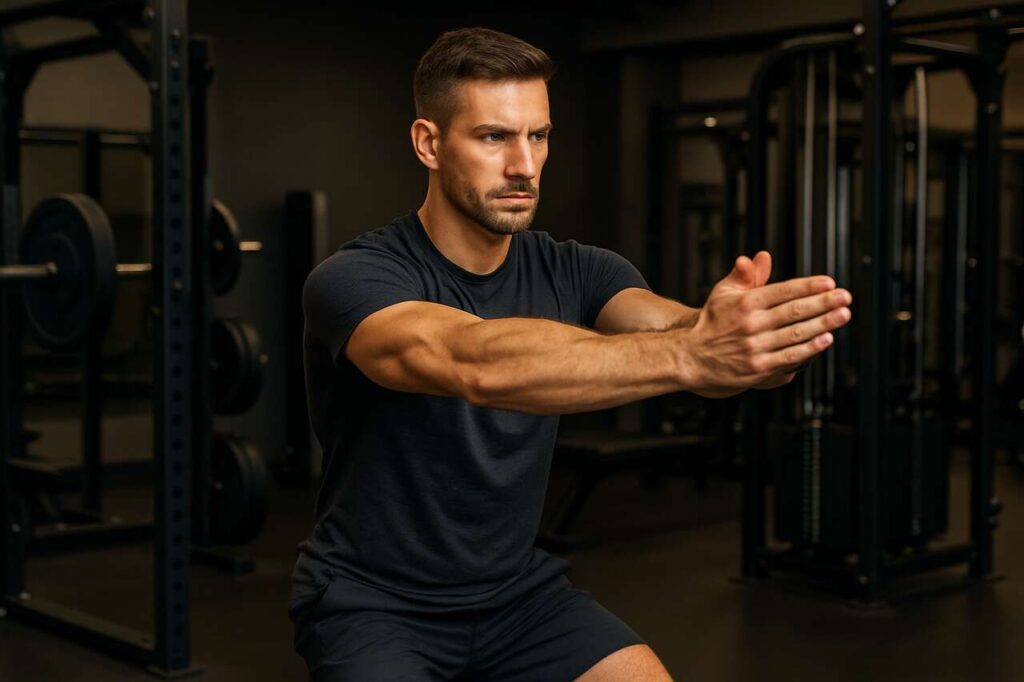
The anti-rotation hold became my primary tool for developing rotational core stability. This exercise challenges the core to resist unwanted rotation whilst maintaining an upright position, directly applicable to countless real-world scenarios.
To perform the anti-rotation hold:
- Attach a resistance band to a fixed point at chest height
- Stand perpendicular to the anchor point, feet shoulder-width apart
- Grasp the band with both hands at chest level
- Step away to create tension in the band
- Extend arms straight ahead, resisting the band’s pull to rotate your torso
- Hold this position for 20-40 seconds, maintaining neutral spine alignment
The key to effectiveness lies in maintaining perfect posture whilst the band attempts to rotate your body. Your obliques, transverse abdominis, and deep spinal stabilisers work intensely to prevent movement. I typically perform three sets per side, progressively increasing resistance as strength improves.
Building on this foundation of rotational stability, the next exercise introduced a dynamic lifting pattern.
Second alternative: the standing lift
The standing lift, also known as the Pallof lift or high-to-low chop, adds a dynamic component to core training whilst maintaining the benefits of upright positioning. This movement pattern mimics everyday actions like placing objects on high shelves or lifting items from the ground.
Execution involves:
- Securing a resistance band at shoulder height
- Standing sideways to the anchor point with feet hip-width apart
- Holding the band with both hands near the lower ribs
- Pressing the band diagonally upward and across the body
- Controlling the return to starting position
- Completing 10-15 repetitions before switching sides
This exercise demands coordinated core activation throughout the entire movement arc. The obliques engage to control rotation, whilst the rectus abdominis and erector spinae maintain spinal stability. I found this particularly beneficial for improving my performance in rotational sports and reducing lower back discomfort.
The final exercise in my core rebuilding trilogy focused on vertical flexion patterns.
Third alternative: standing crunch
The standing crunch provides anterior core strengthening without the neck strain often associated with floor-based crunches. This exercise trains the core to flex the spine whilst managing resistance and maintaining balance.
Proper technique requires:
- Attaching a resistance band overhead or using a cable machine
- Standing facing the anchor point, holding the band behind your head
- Engaging the core to flex the spine, bringing elbows towards knees
- Maintaining a controlled tempo throughout the movement
- Performing 12-20 repetitions for three sets
Unlike traditional crunches, this variation keeps constant tension on the core throughout the entire range of motion. The standing position also engages the lower body for stability, creating a more comprehensive training effect. I noticed significant improvements in my ability to generate power from my core during compound movements.
Having established these three foundational exercises, the question becomes how to integrate them effectively into a broader training programme.
Incorporating these exercises into your fitness routine
Strategic implementation of these standing core exercises maximises their effectiveness whilst avoiding overtraining. I recommend beginning with two to three sessions weekly, allowing adequate recovery between core-focused workouts.
A sample weekly structure might include:
| Day | Exercise Focus | Volume |
|---|---|---|
| Monday | Anti-rotation holds | 3 sets × 30 seconds each side |
| Wednesday | Standing lifts | 3 sets × 12 reps each side |
| Friday | Standing crunches | 3 sets × 15 reps |
These exercises integrate seamlessly into existing programmes, either as a dedicated core session or incorporated into upper body or full-body workouts. I typically perform them towards the end of training sessions when the core is pre-fatigued from compound movements, enhancing their effectiveness.
Progressive overload remains essential: gradually increase resistance, duration, or repetitions as strength improves. Listen to your body and prioritise quality of movement over quantity.
Rebuilding core strength through standing exercises has profoundly impacted my training effectiveness and functional capacity. The anti-rotation hold, standing lift, and standing crunch address the limitations of traditional planks whilst providing superior transfer to real-world movements. These exercises engage the core as a dynamic stabiliser rather than a static structure, developing strength that translates directly to improved performance in sports, daily activities, and injury prevention. By shifting focus from floor-based static holds to upright dynamic movements, you can unlock new levels of core functionality and overcome training plateaus that traditional approaches cannot address.