


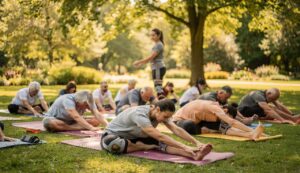

Maintaining physical strength becomes increasingly vital as we age, and few exercises reveal core stability quite like the plank. This deceptively simple position, requiring you to hold your body rigid and parallel to the ground, serves as an excellent benchmark for overall fitness. For those over 50, the ability to hold a proper plank for a specific duration indicates not just muscular strength but also functional fitness that translates into daily activities. Recent fitness assessments suggest that holding a plank for 60 to 90 seconds after age 50 places you well above average, demonstrating exceptional core conditioning that many struggle to achieve.
Importance of strengthening the core after 50
Protecting your spine and preventing injury
The core muscles form a protective corset around your spine, providing essential support that becomes increasingly critical with age. As we pass 50, natural degenerative changes affect spinal discs and vertebrae, making a strong core your first line of defence against back pain and injury. A well-conditioned midsection distributes physical stress more evenly across your body, reducing the burden on individual joints and bones.
Research consistently demonstrates that individuals with stronger cores experience:
- Fewer episodes of lower back pain
- Reduced risk of falls and balance-related injuries
- Better posture throughout daily activities
- Enhanced spinal stability during movement
- Improved recovery from physical strain
Maintaining independence and mobility
Core strength directly influences your ability to perform everyday tasks that younger people take for granted. Getting up from a chair, carrying shopping bags, reaching for items on high shelves, and even getting dressed all require core engagement. Without adequate strength in these muscles, simple activities become challenging, potentially compromising your independence.
| Daily Activity | Core Muscles Engaged | Impact of Weak Core |
|---|---|---|
| Rising from seated position | Rectus abdominis, obliques | Difficulty standing, reliance on arms |
| Climbing stairs | Transverse abdominis, erector spinae | Poor balance, increased fall risk |
| Carrying objects | Obliques, multifidus | Back strain, compensatory movements |
Understanding why core strength matters naturally leads to exploring the specific techniques that can help you hold a plank position for longer periods.
Techniques for holding the plank longer
Perfecting your body alignment
Proper form serves as the foundation for extended plank holds. Your body should form a straight line from head to heels, with your shoulders positioned directly above your elbows. Many people unknowingly sabotage their efforts through subtle misalignments that create unnecessary strain and fatigue.
Key alignment points include:
- Engaging your glutes to prevent hip sagging
- Pulling your navel towards your spine
- Keeping your neck neutral by looking at the floor
- Distributing weight evenly across your forearms
- Maintaining active shoulders rather than collapsing
Breathing strategies for endurance
Many people hold their breath during planks, which rapidly depletes oxygen and triggers early fatigue. Controlled breathing makes a remarkable difference in how long you can maintain the position. Focus on steady, rhythmic breaths that keep your core engaged whilst delivering oxygen to working muscles.
Practise inhaling through your nose for four counts and exhaling through your mouth for four counts. This pattern prevents breath-holding whilst maintaining the abdominal tension necessary for proper form.
Mental focus and distraction techniques
The psychological component of planking often proves as challenging as the physical demands. Rather than watching a clock, try mental strategies that shift your focus away from discomfort. Some people count backwards, recite lyrics, or visualise their muscles growing stronger with each passing second.
These mental approaches work alongside physical techniques, but various factors also influence how long you can realistically hold a plank.
Factors influencing your endurance
Body composition and weight distribution
Your physical build significantly affects plank performance. Individuals carrying excess weight around their midsection face greater gravitational pull, making the exercise more challenging. Conversely, those with lower body fat percentages often find planks easier, though muscle mass also plays a crucial role in overall endurance.
Previous training history
Your exercise background creates a foundation that either supports or limits your plank capacity. Someone who has maintained regular physical activity throughout their life typically demonstrates better neuromuscular coordination and muscular endurance than someone just beginning their fitness journey after 50.
Consider these influential factors:
- Years of consistent exercise participation
- Types of activities previously performed
- Frequency of core-specific training
- Recovery from past injuries
- Overall cardiovascular fitness level
Age-related physiological changes
Biological changes after 50 affect muscle fibre composition, with a natural decline in fast-twitch muscle fibres that contribute to strength and power. Hormonal shifts also influence muscle maintenance and recovery capacity. However, these changes don’t prevent improvement; they simply mean progress may occur more gradually than in younger years.
Understanding these limiting factors helps contextualise the substantial benefits that come from developing superior plank endurance.
Health benefits of a strong plank
Improved metabolic function
Building core strength through planking activates multiple muscle groups simultaneously, creating a metabolic boost that extends beyond the exercise itself. Stronger muscles require more energy at rest, contributing to better weight management and glucose regulation.
Enhanced balance and coordination
The stability required for proper plank execution translates directly into better balance during daily activities. This improvement reduces fall risk, which becomes increasingly important as we age and bone density naturally decreases.
Balance benefits include:
- Improved proprioception (body awareness in space)
- Faster reflexive responses to instability
- Greater confidence during physical activities
- Reduced fear of falling
Cardiovascular advantages
Whilst primarily a strength exercise, holding a plank elevates your heart rate and challenges your cardiovascular system. This sustained muscular contraction requires increased blood flow and oxygen delivery, providing modest but meaningful cardiovascular conditioning alongside strength development.
Recognising these benefits naturally motivates the pursuit of better performance through targeted improvement strategies.
Tips to improve your performance
Progressive overload principles
Improvement requires gradually increasing the challenge placed on your muscles. Rather than attempting maximum holds daily, build endurance through systematic progression. Start with shorter holds performed multiple times, gradually extending duration as your strength increases.
| Week | Hold Duration | Sets | Rest Between Sets |
|---|---|---|---|
| 1-2 | 20-30 seconds | 3 | 60 seconds |
| 3-4 | 30-45 seconds | 3 | 60 seconds |
| 5-6 | 45-60 seconds | 3 | 45 seconds |
| 7-8 | 60-90 seconds | 2-3 | 45 seconds |
Incorporating plank variations
Different plank variations challenge your core from various angles, building comprehensive strength that supports longer standard plank holds. Side planks target obliques, whilst plank variations with leg lifts or arm reaches increase difficulty and engage stabilising muscles more intensely.
Supporting exercises and complementary training
Your plank performance improves when you strengthen surrounding muscle groups. Exercises targeting your glutes, shoulders, and back all contribute to better plank endurance by reducing the burden on your core muscles alone.
Effective complementary exercises include:
- Glute bridges for hip and posterior chain strength
- Dead bugs for core control and coordination
- Bird dogs for balance and spinal stability
- Shoulder taps in plank position for dynamic stability
Even with proper progression and training, certain errors can undermine your efforts and potentially cause injury.
Common mistakes to avoid when planking
Allowing your hips to sag
The most frequent error involves letting your hips drop towards the floor, which places excessive stress on your lower back whilst reducing core engagement. This typically occurs as fatigue sets in, but maintaining proper hip height remains essential throughout the entire hold.
Raising your bottom too high
The opposite problem, lifting your hips above shoulder level, makes the exercise easier but dramatically reduces its effectiveness. This position shifts work away from your core and into your shoulders, defeating the purpose of the exercise.
Holding your breath
Breath-holding creates unnecessary tension and rapidly depletes your endurance. It also elevates blood pressure dangerously, particularly concerning for those over 50. Consistent breathing should remain a non-negotiable aspect of proper plank technique.
Neglecting shoulder position
Allowing your shoulders to collapse or shift forward compromises stability and creates unnecessary strain. Your shoulders should remain actively engaged, with your shoulder blades slightly pulled together and down your back throughout the hold.
The ability to hold a plank for 60 to 90 seconds after age 50 demonstrates exceptional core strength that translates into meaningful health benefits and functional fitness. This achievement requires proper technique, progressive training, and attention to common pitfalls that undermine performance. Core strength protects your spine, maintains independence, improves balance, and supports metabolic health. By focusing on alignment, breathing, gradual progression, and complementary exercises, you can build the endurance necessary to join the ranks of those with superior core conditioning. Remember that consistency matters more than perfection, and even modest improvements in plank duration reflect significant gains in overall functional strength.