

Getting your daily steps doesn’t require braving the cold weather or investing in expensive gym equipment. Physical therapists increasingly recommend indoor walking alternatives that deliver similar cardiovascular benefits whilst offering greater convenience and accessibility. These methods prove particularly valuable for individuals with mobility concerns, those living in areas with challenging weather conditions, or anyone seeking to maximise their activity levels without leaving home.
Why walking at home is a good alternative
Indoor walking provides numerous advantages over traditional outdoor exercise, making it an excellent choice for maintaining consistent physical activity. The controlled environment eliminates weather-related obstacles that often derail exercise routines, whilst reducing exposure to air pollution and allergens that can affect respiratory health.
Health benefits comparable to outdoor walking
Research demonstrates that indoor walking alternatives can deliver equivalent cardiovascular benefits to outdoor walking when performed with proper intensity and duration. These activities elevate heart rate, improve circulation, and strengthen muscles just as effectively as pavement pounding. The key lies in maintaining consistent movement and appropriate exertion levels.
- Reduced joint impact on softer indoor surfaces
- Lower risk of trips and falls on uneven terrain
- Enhanced privacy for those self-conscious about exercising publicly
- Flexibility to exercise at any time regardless of daylight hours
Accessibility for all fitness levels
Home-based walking alternatives accommodate various fitness levels and physical limitations. Individuals recovering from injuries can gradually rebuild strength without the unpredictability of outdoor environments. Those with chronic conditions such as arthritis benefit from the ability to pause immediately when needed and access comfort measures like supportive seating or temperature control.
Understanding these advantages naturally leads to exploring specific techniques that transform your living space into an effective exercise environment.
The method of marching in place
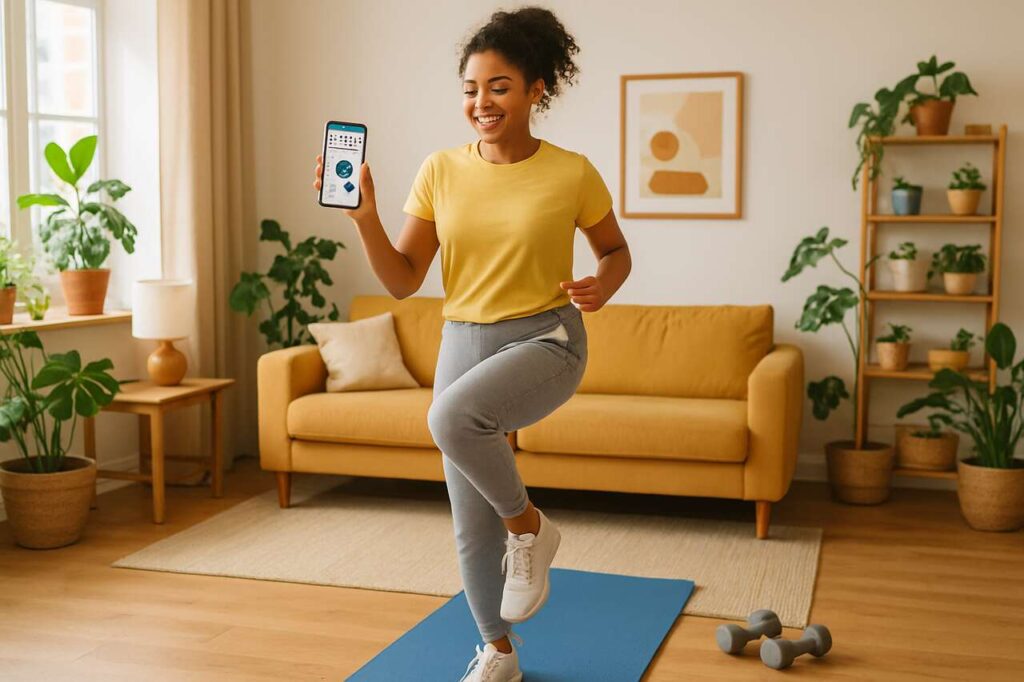
Marching in place represents the simplest transition from outdoor to indoor walking. This fundamental exercise requires no equipment and can be performed in spaces as small as a few square feet, making it ideal for flats or homes with limited room.
Proper form and technique
Effective marching begins with maintaining upright posture with shoulders back and core engaged. Lift knees to hip height whilst swinging arms naturally in opposition to leg movements. Land softly on the balls of your feet to minimise impact whilst maintaining a steady rhythm that elevates your heart rate into the moderate intensity zone.
| Duration | Intensity | Approximate Steps |
|---|---|---|
| 10 minutes | Moderate pace | 800-1,000 |
| 20 minutes | Moderate pace | 1,600-2,000 |
| 30 minutes | Brisk pace | 2,500-3,000 |
Variations to increase difficulty
Progress your marching routine by incorporating high knees, where you lift knees above hip level, or add arm raises overhead to engage upper body muscles. Introduce intervals by alternating between standard marching and faster-paced segments lasting 30 to 60 seconds.
Whilst marching provides excellent cardiovascular benefits, adding rhythmic variety can make indoor exercise more enjoyable and engaging.
Dance to increase your daily steps
Dancing transforms step counting into an entertaining activity that barely feels like exercise. This approach combines cardiovascular benefits with improved coordination, balance, and mood enhancement through music and creative movement.
Styles suitable for step accumulation
Various dance styles effectively boost daily step counts whilst catering to different preferences and abilities. Zumba-inspired movements incorporate Latin rhythms with easy-to-follow steps that keep you constantly moving. Line dancing offers structured routines that build familiarity over time, whilst freestyle dancing allows complete creative freedom to move however feels natural.
- Ballroom-inspired steps for elegant, flowing movements
- Hip-hop routines for higher intensity workouts
- Folk dancing patterns that emphasise footwork
- Jazz movements combining style with cardiovascular challenge
Creating your dance routine
Design a sustainable dance practice by selecting music that motivates you and setting realistic duration goals. Begin with 10-minute sessions and gradually extend as stamina improves. Focus on continuous movement rather than perfect technique, as the primary goal remains accumulating steps and maintaining elevated heart rate.
Beyond dance, structured exercises offer another avenue for achieving step goals without leaving home.
Cardio exercises at home
Targeted cardiovascular exercises provide efficient alternatives to traditional walking whilst engaging multiple muscle groups simultaneously. These movements often generate higher step counts in shorter periods compared to steady-state walking.
Step-counting cardio movements
Several bodyweight exercises effectively accumulate steps whilst delivering comprehensive fitness benefits. Jumping jacks engage the entire body whilst rapidly increasing step counts. Step touches, where you alternately tap feet to the side, provide lower-impact options. Mountain climbers, performed from a plank position, combine core strengthening with rapid leg movements that register as steps on most fitness trackers.
Circuit training for maximum steps
Combine multiple exercises into circuits that maintain constant movement and prevent boredom. Alternate between high-intensity movements and moderate-paced activities to sustain effort over longer periods.
| Exercise | Duration | Estimated Steps |
|---|---|---|
| Jumping jacks | 2 minutes | 200-250 |
| High knees | 2 minutes | 180-220 |
| Butt kicks | 2 minutes | 160-200 |
Technology can further enhance these indoor activities by providing structure, motivation, and variety.
Using indoor walking apps and videos
Digital resources offer guided experiences that replicate outdoor walking benefits whilst adding entertainment and instruction. These tools prove particularly valuable for maintaining motivation and ensuring proper technique.
Popular walking apps and platforms
Numerous applications specialise in indoor walking workouts, offering programmes ranging from beginner to advanced levels. YouTube channels provide free walking workouts of various durations and styles, whilst subscription services deliver structured programmes with progression tracking. Virtual reality applications create immersive environments that simulate outdoor walks through scenic locations.
- Leslie Sansone’s Walk at Home series
- FitOn’s indoor walking programmes
- Walking Pad treadmill apps with virtual routes
- Fitness tracker apps with indoor walking modes
Maximising app effectiveness
Select programmes that match your current fitness level and gradually progress to more challenging options. Schedule regular workout times to establish consistency, and vary your chosen videos to prevent monotony. Many apps include community features that provide accountability and social connection despite exercising alone at home.
Beyond dedicated exercise sessions, simple lifestyle adjustments can dramatically increase daily movement without formal workouts.
Adjusting your daily routine for more activity
Strategic modifications to everyday activities accumulate significant step counts throughout the day without requiring dedicated exercise time. These micro-movements integrate seamlessly into existing routines whilst delivering measurable health benefits.
Household activity opportunities
Transform routine tasks into movement opportunities by adopting more active approaches. Walk whilst talking on the phone rather than sitting. Pace during television commercial breaks or between episodes. Take multiple trips when putting away groceries or laundry instead of carrying everything at once.
Workspace movement strategies
For those working from home, implement regular movement breaks every 30 to 60 minutes. Stand and march in place during video calls when camera positioning allows. Walk to different rooms for various tasks rather than keeping everything within arm’s reach. Set hourly reminders to complete brief walking sessions of five minutes.
- Walk whilst reviewing documents or reading emails on mobile devices
- Conduct walking meetings for phone calls
- Use stairs repeatedly if available in your home
- Park cleaning supplies in distant locations requiring extra steps
Achieving daily step goals doesn’t require outdoor excursions or gym memberships. The four strategies outlined provide effective alternatives that accommodate various preferences, fitness levels, and living situations. Marching in place offers simplicity and accessibility, dancing adds enjoyment, structured cardio exercises maximise efficiency, and digital resources provide guidance and variety. Combined with thoughtful routine adjustments, these approaches ensure consistent physical activity regardless of external circumstances. The key lies in selecting methods that align with personal preferences and maintaining consistency over time, transforming indoor spaces into effective environments for health and fitness.