

Running places considerable demands on the body, particularly the legs and lower back. Many runners focus exclusively on cardiovascular training and distance, often neglecting the foundational strength work that prevents common injuries. Pilates offers a targeted approach to building the core stability and glute strength that runners need to maintain proper form, reduce impact stress, and stay on the road longer. A qualified Pilates instructor has identified five essential movements that address the specific weaknesses runners develop, creating a balanced training programme that complements high-mileage weeks and tempo sessions.
The importance of Pilates for runners
Why runners need Pilates
Running is a repetitive, forward-moving activity that creates muscular imbalances over time. Pilates addresses these imbalances by strengthening underused muscle groups whilst improving flexibility and body awareness. The method focuses on controlled movements that emphasise quality over quantity, teaching runners to engage muscles correctly during each stride.
The discipline targets the deep stabilising muscles that support the spine and pelvis, areas that frequently weaken in runners who log high weekly mileage. These foundational muscles act as shock absorbers, reducing the impact forces that travel through the body with each foot strike. Without adequate core and glute strength, runners compensate with other muscle groups, leading to common injuries such as:
- Iliotibial band syndrome
- Patellofemoral pain syndrome
- Plantar fasciitis
- Lower back pain
- Hip flexor strains
The connection between stability and performance
Beyond injury prevention, Pilates enhances running economy by improving posture and movement efficiency. When the core provides a stable platform, the limbs can move more freely and powerfully. Runners who incorporate Pilates work often notice improved breathing capacity, as the exercises strengthen the muscles responsible for proper respiratory mechanics during exertion.
Understanding these fundamental benefits sets the stage for exploring the specific movements that deliver the greatest returns for runners’ time investment.
Strengthening the core: solid abdominals
The hundred: breath and endurance
This classic Pilates exercise builds abdominal endurance whilst coordinating breath with movement. Lying supine with legs in tabletop position, the runner lifts the head and shoulders, extending arms alongside the body. The movement involves pulsing the arms up and down whilst breathing in for five counts and out for five counts, repeating for one hundred pulses.
The hundred teaches runners to maintain core engagement whilst breathing deeply, a skill directly transferable to maintaining form during challenging runs. The exercise strengthens the rectus abdominis and transverse abdominis, creating the anterior support needed for upright running posture.
Single leg stretch: dynamic stability
This exercise mimics the alternating leg pattern of running whilst demanding core control. Starting in a supine position with both knees drawn towards the chest, the runner extends one leg whilst drawing the opposite knee closer, switching legs in a controlled rhythm. The core remains engaged throughout, preventing the lower back from arching away from the mat.
Single leg stretch develops the ability to maintain pelvic stability whilst the legs move independently, directly addressing the dynamic demands of running gait. The movement pattern strengthens the obliques and hip flexors whilst teaching proper breathing coordination.
With a strong abdominal foundation established, attention must turn to the posterior chain muscles that power forward propulsion.
Targeted glute exercises
Bridge: glute activation and hip extension
The bridge exercise addresses glute weakness, one of the most common issues affecting runners. Lying supine with knees bent and feet flat, the runner lifts the hips towards the ceiling, creating a straight line from shoulders to knees. The focus remains on squeezing the glutes rather than pushing through the lower back.
This movement strengthens the gluteus maximus, the primary hip extensor used during the push-off phase of running. Variations include single-leg bridges and bridges with leg extensions, progressively challenging stability and strength.
Side-lying leg series: lateral stability
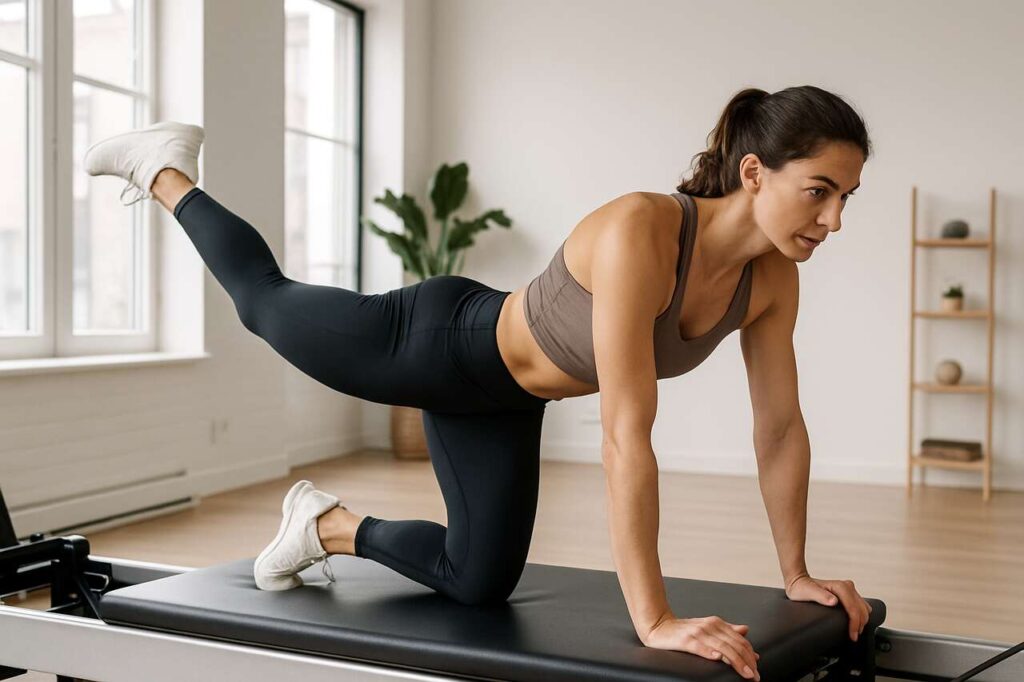
Lying on one side with the body in a straight line, runners perform small, controlled leg lifts and circles. These movements target the gluteus medius, the muscle responsible for stabilising the pelvis during single-leg stance. Weak gluteus medius muscles allow the pelvis to drop with each step, creating excessive lateral movement and increasing injury risk.
| Exercise | Primary muscle group | Running benefit |
|---|---|---|
| Bridge | Gluteus maximus | Powerful push-off |
| Side-lying leg lift | Gluteus medius | Pelvic stability |
| Clam shells | Hip external rotators | Knee alignment |
These targeted glute exercises create the strength foundation necessary to protect runners from the mechanical stresses that lead to common injuries.
The benefits of Pilates in injury prevention
Addressing muscular imbalances
Running creates predictable patterns of tightness and weakness. Pilates systematically addresses these imbalances by strengthening underactive muscles whilst lengthening overactive ones. The hip flexors, which become chronically tight in runners, receive attention through exercises that combine strengthening with controlled stretching.
The method’s emphasis on symmetrical movement patterns helps identify and correct side-to-side differences that contribute to injury. Many runners discover they favour one leg or have significantly weaker glutes on one side, issues that Pilates work brings to conscious awareness.
Improving proprioception and body awareness
Proprioception, the body’s ability to sense its position in space, improves dramatically through regular Pilates practice. This enhanced awareness translates to better running form, as runners become more attuned to postural deviations and compensatory patterns. The slow, controlled nature of Pilates movements allows time for neural pathways to strengthen, creating lasting changes in movement quality.
Understanding how Pilates prevents injuries naturally leads to considering how to incorporate these exercises into an existing training schedule.
Daily routine to optimise performance
Creating a sustainable practice
Consistency matters more than duration when integrating Pilates into a running programme. A fifteen-minute daily session delivers better results than sporadic hour-long workouts. The five movements identified by the Pilates instructor can be performed in sequence, creating a complete routine that addresses core and glute strength comprehensively.
Runners should consider performing Pilates work on recovery days or after easy runs when the body is warm but not fatigued. Morning sessions before breakfast can establish a consistent habit, whilst evening practice may help release tension accumulated during the day.
Progression and adaptation
Beginning with basic variations of each exercise allows proper form development. As strength improves, runners can add repetitions, increase hold times, or progress to more challenging versions. The instructor recommends mastering the fundamental movement patterns before advancing, as poor form in basic exercises negates the benefits of more complex variations.
These practical implementation strategies prepare runners to receive expert guidance on maximising the effectiveness of their Pilates practice.
A Pilates instructor’s tips for runners
Quality over quantity
The instructor emphasises that precise execution matters more than repetition count. Five perfectly performed bridges provide greater benefit than twenty rushed repetitions with poor form. Runners should focus on feeling the target muscles working, maintaining steady breathing, and moving with control throughout each exercise.
Breathing techniques
Proper breathing patterns enhance exercise effectiveness whilst teaching skills applicable to running. Lateral thoracic breathing, where the ribcage expands sideways rather than the belly pushing forward, maintains core engagement whilst allowing full oxygen exchange. This breathing pattern supports the spine and improves running economy.
Listening to the body
Pain signals require attention rather than dismissal. The instructor advises modifying exercises that cause discomfort, working within a comfortable range of motion whilst gradually expanding capabilities. Pilates should challenge muscles without stressing joints or creating compensatory patterns.
Runners who commit to regular Pilates practice alongside their running training develop the foundational strength and stability that supports long-term participation in the sport. The five exercises outlined provide a practical starting point, addressing the core and glute weaknesses that contribute to common running injuries. By investing modest time in these targeted movements, runners build resilience that pays dividends in reduced injury rates, improved performance, and greater enjoyment of their training.