



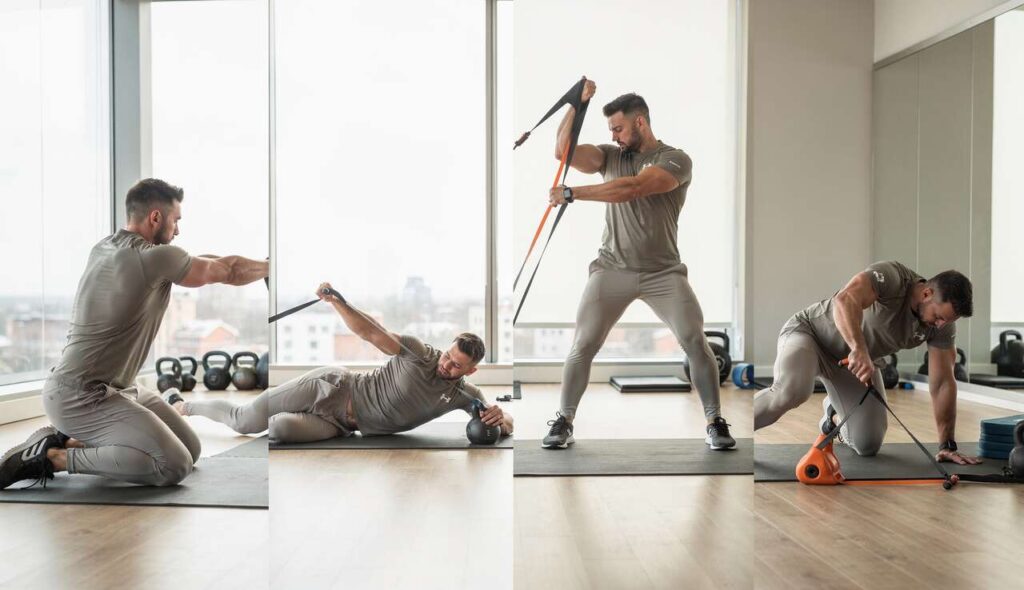
Strengthening your core goes far beyond achieving visible abdominal definition. The deep core muscles form the foundation of functional movement, stability and overall physical health. According to a certified personal trainer, you don’t need expensive equipment or complicated routines to effectively target these crucial muscles. With just four carefully selected moves and a simple resistance band, you can build a stronger, more resilient core that supports every aspect of your daily life and athletic performance.
Understanding the importance of deep core muscles
What are the deep core muscles ?
The deep core muscles consist of several layers of musculature that work together to provide stability and support to the spine and pelvis. Unlike the superficial rectus abdominis that creates the six-pack appearance, these deeper structures include the transverse abdominis, multifidus, pelvic floor muscles and diaphragm. These muscles function as an internal corset, wrapping around the torso to maintain proper posture and protect the spine during movement.
Why targeting deep core muscles matters
Focusing on deep core musculature offers numerous benefits that extend well beyond aesthetic considerations. These muscles play a vital role in:
- Preventing lower back pain and reducing existing discomfort
- Improving balance and coordination during daily activities
- Enhancing athletic performance across various sports
- Supporting proper breathing mechanics
- Protecting internal organs and maintaining healthy posture
- Facilitating efficient force transfer between upper and lower body
Research demonstrates that individuals with weak deep core muscles are significantly more susceptible to injuries, particularly in the lower back region. Strengthening these muscles creates a solid foundation that supports virtually every movement pattern, from lifting groceries to performing complex athletic manoeuvres.
The difference between superficial and deep core training
Traditional abdominal exercises like crunches and sit-ups primarily target the superficial muscles, whilst deep core training requires specific movements that engage the stabilising musculature. Deep core work emphasises controlled, sustained contractions rather than rapid repetitions, focusing on quality over quantity. This approach builds functional strength that translates directly to improved performance in everyday activities.
Understanding this distinction helps explain why resistance bands prove particularly effective for this type of training, as they provide consistent tension that challenges the stabilising muscles throughout each movement.
The role of resistance bands in core muscle training
Why resistance bands are ideal for core work
Resistance bands offer several distinct advantages for targeting deep core muscles. Unlike free weights that rely primarily on gravity, bands create variable resistance that increases as the band stretches, challenging muscles throughout the entire range of motion. This constant tension forces the deep core muscles to engage continuously, maintaining stability against the pulling force.
The versatility of resistance bands allows for multidirectional training, which mirrors the way core muscles function in real-world scenarios. Additionally, bands are:
- Affordable and accessible for home training
- Portable and convenient for travel
- Suitable for all fitness levels through varying resistance levels
- Gentle on joints whilst still providing effective resistance
- Capable of creating instability that further engages stabilising muscles
How resistance bands activate deep core muscles
When using resistance bands for core training, the body must work against unpredictable forces that pull in various directions. This challenges the deep core muscles to fire in coordination, maintaining proper alignment and preventing unwanted rotation or flexion. The elastic nature of bands creates a unique stimulus that differs from traditional weight training, requiring constant micro-adjustments from the stabilising musculature.
| Training Method | Primary Muscle Engagement | Stability Requirement |
|---|---|---|
| Free weights | Superficial muscles | Moderate |
| Resistance bands | Deep core muscles | High |
| Bodyweight exercises | Mixed engagement | Variable |
This comparison illustrates why certified personal trainers increasingly recommend resistance bands specifically for deep core development, as they provide the optimal combination of challenge and accessibility.
With this understanding of how resistance bands uniquely target the deep core, we can now explore the specific movements that maximise their effectiveness.
The four essential moves to target deep core muscles
Pallof press: anti-rotation strength
The Pallof press stands as a fundamental anti-rotation exercise that directly targets the deep core muscles. To perform this movement, anchor the resistance band at chest height and stand perpendicular to the anchor point. Hold the band with both hands at your chest, then press straight forward whilst resisting the band’s pull to rotate your torso. The deep core muscles must engage intensely to maintain proper alignment against this rotational force.
This exercise effectively strengthens the transverse abdominis and obliques in their stabilising capacity, which translates directly to improved performance in sports and daily activities that involve rotational movements or resistance to unwanted rotation.
Banded dead bug: coordination and control
The banded dead bug variation adds resistance to a classic core stability exercise. Lie on your back with the band looped around your feet and held with your hands. Extend opposite arm and leg whilst maintaining tension on the band, keeping your lower back pressed firmly against the floor. This movement requires exceptional coordination between the deep core muscles and the diaphragm to maintain spinal stability throughout the exercise.
Standing band rotation: functional power
Standing band rotations develop rotational strength whilst engaging the entire core musculature. Anchor the band at chest height, grasp it with both hands, and rotate away from the anchor point whilst keeping your hips stable. This exercise trains the core muscles to generate and control rotational force, which is essential for activities ranging from tennis serves to simply turning to reach something behind you.
Band pull-through plank: integrated stability
The band pull-through plank combines static and dynamic elements to challenge the deep core muscles comprehensively. Begin in a plank position with a resistance band anchored in front of you. Reach forward with one hand to grab the band, then pull it back towards your hip whilst maintaining a stable plank position. This movement requires the deep core to work intensely to prevent rotation and maintain proper spinal alignment against the asymmetric loading.
These four movements create a comprehensive programme that addresses all aspects of deep core function, but proper execution remains crucial for achieving optimal results.
Tips from a certified personal trainer to optimise your sessions
Focus on breathing and muscle engagement
Proper breathing technique proves essential for maximising deep core activation. The diaphragm functions as part of the core system, and coordinating breath with movement enhances intra-abdominal pressure that supports the spine. Exhale during the exertion phase of each exercise whilst maintaining core tension, avoiding the common mistake of holding your breath, which can increase blood pressure and reduce exercise effectiveness.
Prioritise quality over quantity
Deep core training differs fundamentally from traditional abdominal work in its emphasis on movement quality. Rather than rushing through high repetitions, focus on controlled, deliberate movements that maintain constant tension on the target muscles. Each repetition should be performed with:
- Smooth, controlled tempo throughout the entire range of motion
- Maintained tension on the resistance band at all times
- Proper alignment of the spine and pelvis
- Conscious engagement of the deep core muscles
- Full concentration on the movement pattern
Progress gradually with resistance levels
Selecting appropriate resistance ensures effective training without compromising form. Begin with lighter bands that allow you to complete exercises with perfect technique, then gradually progress to heavier resistance as your strength and control improve. If you find yourself compensating with other muscle groups or losing proper form, reduce the resistance level.
| Experience Level | Recommended Sets | Repetitions per Set | Rest Period |
|---|---|---|---|
| Beginner | 2-3 | 8-10 | 60 seconds |
| Intermediate | 3-4 | 10-12 | 45 seconds |
| Advanced | 4-5 | 12-15 | 30 seconds |
Mind-muscle connection matters
Developing awareness of your deep core muscles enhances training effectiveness significantly. Before beginning each exercise, take a moment to consciously engage your core by drawing your navel towards your spine and activating the pelvic floor. This pre-activation ensures the target muscles are primed to work throughout the movement, rather than allowing larger, more superficial muscles to dominate the exercise.
Understanding these optimisation strategies sets the foundation for successfully integrating these exercises into a sustainable training approach.
Incorporating these exercises into your daily routine
Creating an effective training schedule
Consistency proves more valuable than intensity when developing deep core strength. These four exercises can be performed as a standalone routine three to four times weekly, or integrated into existing training programmes. Allow at least one day of recovery between sessions to permit proper muscle adaptation and growth.
A sample weekly schedule might include:
- Monday: full four-exercise routine
- Tuesday: rest or other training focus
- Wednesday: full four-exercise routine
- Thursday: rest or other training focus
- Friday: full four-exercise routine
- Weekend: active recovery or rest
Combining with other training modalities
These resistance band exercises complement various training approaches effectively. Perform them as a warm-up before strength training to activate the core muscles, or use them as a finisher to thoroughly exhaust the stabilising musculature. They also integrate well with cardiovascular training, Pilates or yoga practices, enhancing overall body awareness and control.
Tracking progress and maintaining motivation
Deep core development occurs gradually, and visible changes may not appear immediately. Track progress through functional improvements such as reduced back pain, better posture, improved balance or enhanced performance in other exercises. Keep a training journal noting resistance levels, repetitions completed and subjective feelings of strength and stability to maintain motivation and identify areas for continued development.
Building a stronger, more functional core requires minimal equipment but delivers substantial benefits across all aspects of physical performance and daily life. These four resistance band exercises provide a comprehensive approach to targeting the deep core muscles that support spinal health, enhance stability and improve overall movement quality. By focusing on proper technique, maintaining consistency and progressively challenging yourself, you can develop the foundational strength that underpins all physical activity. The simplicity and accessibility of this training method removes common barriers to effective core training, making it suitable for individuals at any fitness level seeking to build genuine functional strength rather than merely superficial muscle definition.