

Running remains one of the most accessible forms of exercise, yet it comes with a significant risk of injury. Research indicates that between 50 and 70 per cent of runners experience some form of injury each year, often stemming from muscular imbalances and weaknesses in crucial supporting muscles. Pilates has emerged as an essential cross-training discipline that addresses these vulnerabilities, particularly through targeted work on the core and glutes. These muscle groups serve as the foundation for running efficiency, providing stability, power and protection against common injuries such as runner’s knee, IT band syndrome and lower back pain.
The importance of Pilates for runners
Building a foundation for injury prevention
Pilates offers runners a systematic approach to strengthening the stabilising muscles that traditional running training often neglects. The discipline focuses on controlled movements that enhance body awareness, improve posture and correct muscular imbalances. For runners, this translates into better biomechanics and reduced stress on joints and connective tissues.
The core benefits of Pilates for running performance include:
- Enhanced core stability that maintains proper running form even during fatigue
- Improved glute activation that generates power with each stride
- Greater hip mobility that allows for efficient leg swing
- Better breathing patterns that support endurance
- Increased body awareness that helps identify potential problems early
The science behind Pilates and running performance
Studies have demonstrated that runners who incorporate Pilates into their training routines experience measurable improvements in performance metrics. A stable core acts as a central pillar from which all movement originates, allowing the legs to move more efficiently whilst maintaining proper alignment. When the core is weak, the body compensates by placing additional strain on the legs, hips and lower back.
| Performance metric | Improvement with Pilates |
|---|---|
| Running economy | Up to 12% improvement |
| Core endurance | 25-30% increase |
| Injury rate reduction | 40-50% decrease |
Understanding these benefits provides the foundation for exploring how specific exercises target the muscles most critical to running performance.
Strengthening the core and glutes to prevent injuries
Why glutes matter for runners
The gluteal muscles, particularly the gluteus maximus and gluteus medius, play a pivotal role in running mechanics. These muscles generate the propulsive force needed for forward movement whilst simultaneously stabilising the pelvis and preventing excessive rotation. When glutes are weak or underactive, other muscles must compensate, leading to common running injuries.
Weak glutes contribute to several problematic patterns:
- Excessive inward knee collapse during landing
- Hip drop on the stance leg
- Overreliance on quadriceps and hip flexors
- Increased stress on the IT band
- Poor shock absorption through the kinetic chain
The role of core stability in running
The core encompasses more than just the abdominal muscles; it includes the deep stabilisers of the spine, the pelvic floor and the muscles surrounding the hips. This muscular corset maintains proper posture and transfers force efficiently between the upper and lower body. Without adequate core strength, runners experience energy leaks that reduce efficiency and increase fatigue.
A strong core enables runners to maintain form throughout longer distances, preventing the postural breakdown that often occurs in the final kilometres of a run. This stability becomes even more critical when running on uneven terrain or at faster paces. With this understanding of muscular function established, specific exercises can target these essential areas.
Pelvic curl and leg lift
Mastering the pelvic curl technique
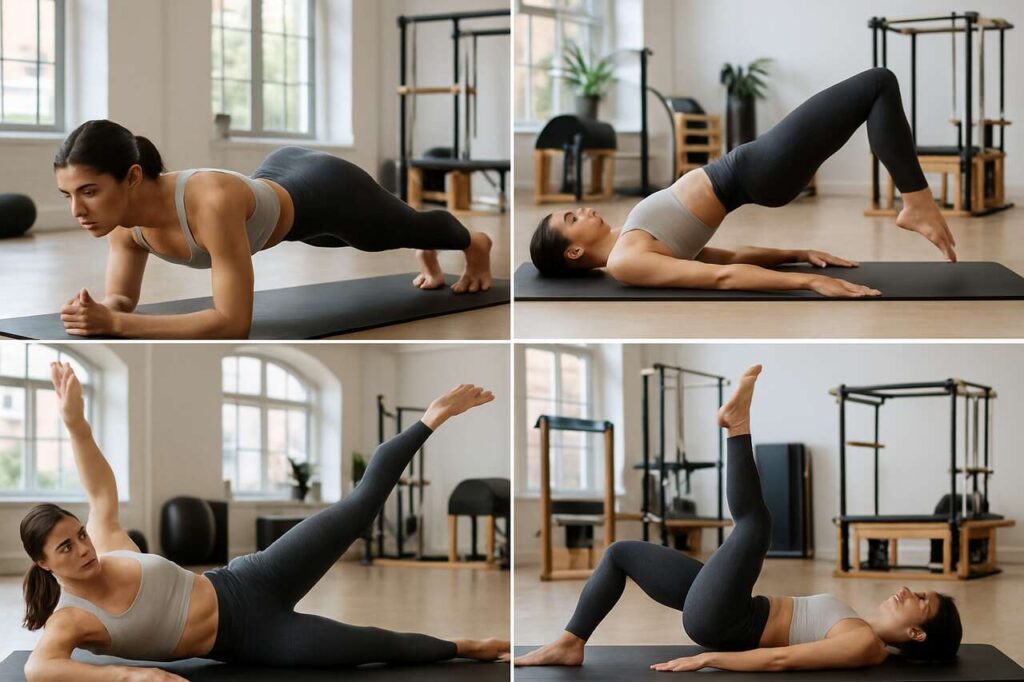
The pelvic curl with single-leg lift stands as one of the most effective exercises for developing glute strength and pelvic stability simultaneously. This movement requires precise control and coordination, making it ideal for runners who need to maintain level hips whilst moving at speed.
To perform this exercise correctly:
- Lie on your back with knees bent and feet hip-width apart
- Engage the core and press through the heels to lift the hips
- Maintain a straight line from shoulders to knees
- Slowly extend one leg whilst keeping the pelvis level
- Lower the leg and repeat on the opposite side
Progressive variations for advancing runners
As strength develops, runners can increase the challenge by extending the hold time at the top position or adding small pulses with the lifted leg. The key focus should remain on maintaining a level pelvis throughout the movement, as any tilting indicates compensatory patterns that could transfer to running gait.
| Level | Sets | Repetitions | Rest period |
|---|---|---|---|
| Beginner | 2 | 6-8 each side | 60 seconds |
| Intermediate | 2-3 | 8-10 each side | 45 seconds |
| Advanced | 3 | 10-12 each side | 30 seconds |
This foundational movement prepares the body for more dynamic exercises that further enhance hip stability.
The benefits of the Clamshell exercise
Targeting the gluteus medius
The Clamshell exercise specifically activates the gluteus medius, a muscle critical for maintaining hip stability during the single-leg stance phase of running. This often-neglected muscle prevents the pelvis from dropping on the unsupported side, a common fault that leads to IT band issues and knee pain.
Proper execution involves lying on one side with knees bent and feet together. Keeping the feet in contact, the top knee lifts whilst the pelvis remains stable. The movement should be controlled and deliberate, focusing on the external rotation at the hip rather than simply opening the knees.
Common mistakes and corrections
Many runners struggle with the Clamshell because they allow compensatory movements that reduce its effectiveness. The most frequent errors include rolling the pelvis backwards, lifting the feet apart or using momentum rather than muscular control.
Key points for optimal execution:
- Maintain neutral spine alignment throughout
- Keep the pelvis stacked vertically
- Focus on initiating movement from the hip
- Avoid lifting the knee too high
- Breathe naturally without holding breath
Building strength through this exercise creates a foundation for the more complex full-body movements that follow.
Enhancing endurance with the Swimming exercise
Full-body coordination for runners
The Swimming exercise develops posterior chain strength whilst improving coordination between opposite limbs, mirroring the cross-body patterns used in running. This movement strengthens the back extensors, glutes and shoulders simultaneously, creating a balanced muscular system that supports efficient running mechanics.
Performed lying face down, the exercise involves alternately lifting opposite arms and legs whilst maintaining a stable torso. The rhythmic alternation challenges the nervous system to coordinate movement patterns similar to those required during running, making it particularly valuable for endurance athletes.
Building endurance through repetition
Unlike strength-focused exercises that use heavy resistance, the Swimming exercise develops muscular endurance through sustained contractions. Runners typically perform this movement for time rather than repetitions, gradually increasing duration as endurance improves.
| Week | Duration | Sets | Focus |
|---|---|---|---|
| 1-2 | 20-30 seconds | 2 | Form and coordination |
| 3-4 | 30-45 seconds | 2-3 | Sustained contraction |
| 5-6 | 45-60 seconds | 3 | Endurance building |
This progressive approach ensures runners develop the stamina needed to maintain proper form throughout their training runs.
Integrating Pilates into runners’ routines
Creating a balanced training schedule
Successful integration of Pilates requires strategic planning within the overall training programme. Rather than adding extra volume that increases fatigue, Pilates sessions should complement running workouts by addressing weaknesses and promoting recovery. Most runners benefit from two to three Pilates sessions per week, scheduled on recovery days or following easy runs.
Optimal scheduling approaches include:
- Morning Pilates sessions followed by evening easy runs
- Pilates on complete rest days to maintain active recovery
- Short 15-20 minute sessions after strength training
- Longer 45-60 minute sessions replacing one weekly run
Measuring progress and adapting exercises
Runners should track improvements in both Pilates performance and running metrics to assess the effectiveness of their cross-training. Indicators of progress include increased repetitions, better form maintenance throughout sets, reduced injury occurrence and improved running economy. As proficiency develops, exercises can be progressed by adding resistance, increasing duration or incorporating more complex movement patterns.
The commitment to consistent Pilates practice yields dividends that extend beyond immediate performance gains, contributing to long-term running health and sustainability.
Incorporating these five essential Pilates exercises into a regular training routine provides runners with the muscular foundation necessary for injury-free performance. The pelvic curl with leg lift, Clamshell, Swimming exercise and complementary core work address the specific weaknesses that plague runners, particularly in the glutes and core stabilisers. By dedicating just two to three sessions weekly to these movements, runners can expect measurable improvements in stability, power generation and overall running economy. The investment in Pilates practice pays dividends through reduced injury rates, enhanced performance and the ability to sustain running participation over many years.