


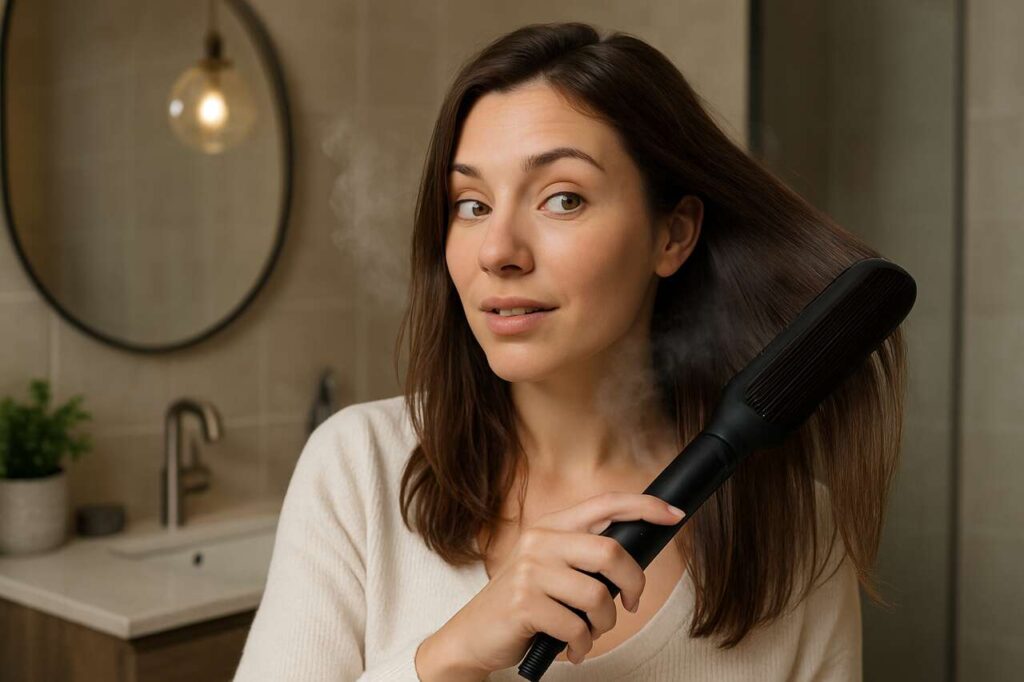
The beauty industry continues to evolve with innovative tools promising to simplify our daily routines. Among these innovations, the straightening dryer has emerged as a popular solution for those seeking to reduce styling time without compromising results. This hybrid device claims to combine the power of a hairdryer with the smoothing capabilities of a straightener, offering salon-quality results at home. But does this multitasking tool truly live up to its promises, or is it simply another gadget destined to gather dust in your bathroom drawer ?
Introduction to the straightening dryer: definition and operation
What exactly is a straightening dryer ?
A straightening dryer represents a two-in-one styling tool designed to dry and straighten hair simultaneously. Unlike traditional hairdryers that simply blow hot air, these devices incorporate smoothing technology through various mechanisms such as heated plates, tension brushes, or specialised airflow patterns. The primary objective is to eliminate the need for multiple styling steps, allowing users to achieve smooth, straight hair directly from wet or damp hair.
The technology behind the device
Most straightening dryers operate using one of several key technologies:
- Heated brush attachments that combine airflow with ceramic or tourmaline-coated bristles
- Paddle-style designs featuring wide plates that glide through hair sections
- Rotating brush systems that create tension whilst directing heated air
- Ionic technology to reduce frizz and enhance shine
The devices typically feature multiple heat and speed settings, allowing users to customise the styling process according to their hair type and desired results. Many models incorporate automatic temperature control to prevent heat damage, whilst others include cool shot functions to set the style.
Understanding how these devices work sets the foundation for comparing them to traditional styling tools and evaluating their effectiveness.
The differences between a standard hairdryer and a straightener
Fundamental operational distinctions
Traditional hairdryers and flat iron straighteners serve distinctly different purposes in hair styling. A standard hairdryer focuses solely on removing moisture through heated airflow, whilst a flat iron straightener uses direct heat and pressure to reshape the hair cuticle. The straightening dryer attempts to bridge this gap by performing both functions simultaneously.
| Feature | Standard Hairdryer | Flat Iron | Straightening Dryer |
|---|---|---|---|
| Primary function | Drying | Straightening | Both |
| Heat application | Indirect airflow | Direct plate contact | Combined method |
| Time required | 5-10 minutes | 10-15 minutes | 10-20 minutes |
| Hair must be | Wet | Completely dry | Damp to dry |
Styling outcomes and versatility
The results achieved with each tool vary considerably. Flat irons deliver the sleekest, most polished finish with maximum straightness, but require fully dry hair and a separate drying step. Standard hairdryers offer the most versatility for different styles but provide minimal straightening effect. Straightening dryers fall somewhere between these extremes, offering moderate straightening with reasonable drying efficiency.
These distinctions become crucial when weighing the practical benefits and limitations of adopting a straightening dryer into your routine.
Advantages and disadvantages of the straightening dryer
Key benefits for users
The straightening dryer presents several compelling advantages for specific user groups:
- Time efficiency: eliminates the need for separate drying and straightening sessions
- Reduced heat exposure: fewer passes through hair compared to traditional two-step processes
- Ease of use: simpler technique than coordinating a brush and hairdryer
- Travel convenience: one device instead of multiple tools
- Gentler on hair: less direct heat contact than flat irons
For individuals with naturally straight or slightly wavy hair, these devices can deliver impressive results whilst genuinely saving time. The reduced manipulation also means less potential for heat damage when used correctly.
Notable limitations and drawbacks
Despite the benefits, several significant disadvantages merit consideration:
- Limited effectiveness on very curly hair: may not achieve desired straightness
- Longer styling time than claimed: often requires multiple passes per section
- Learning curve: technique differs from traditional methods
- Inconsistent results: performance varies significantly between brands
- Higher initial investment: quality models typically cost more than basic hairdryers
Users with thick, coarse, or highly textured hair frequently report disappointing results, finding that traditional straightening methods remain more effective. The weight and bulk of some models can also cause arm fatigue during use.
These considerations naturally lead to the question of how to identify which device might work best for your particular hair type and styling needs.
How to choose the right model based on your needs
Assessing your hair type and texture
Your hair characteristics should dictate your choice of straightening dryer. Fine to medium hair with minimal natural curl responds best to these devices, whilst thick or highly textured hair requires models with higher heat settings and more powerful motors. Consider the following factors:
- Hair thickness: denser hair needs wider plates or brushes
- Natural texture: tighter curls require higher temperatures
- Hair length: longer hair benefits from larger surface areas
- Damage level: compromised hair needs lower heat and protective features
Essential features to prioritise
When evaluating models, certain features prove more valuable than others. Look for devices offering adjustable temperature settings ranging from 150°C to 230°C, allowing customisation for different hair types. Ionic technology significantly reduces frizz and static, whilst ceramic or tourmaline coatings ensure even heat distribution.
Additional considerations include cord length for manoeuvrability, weight for comfortable handling, and automatic shut-off for safety. Warranty coverage and customer service reputation also indicate manufacturer confidence in product durability.
Armed with this knowledge, examining specific brands and models helps translate these criteria into practical purchasing decisions.
Comparison of popular brands and models
Leading market options
Several brands dominate the straightening dryer market, each offering distinct approaches to the technology:
| Brand/Model | Price Range | Best For | Key Feature |
|---|---|---|---|
| Revlon One-Step | £30-£50 | Fine to medium hair | Oval brush design |
| Dyson Airwrap | £400-£500 | All hair types | Coanda effect technology |
| BaByliss Big Hair | £40-£70 | Volume and smoothing | Rotating brush |
| ghd Duet Style | £350-£400 | Wet to dry styling | Air-fusion technology |
Performance analysis
Budget-friendly options like the Revlon One-Step deliver surprisingly effective results for those with cooperative hair types, making them excellent entry points. Mid-range devices from established brands such as BaByliss offer reliable performance with better durability. Premium options like the Dyson Airwrap provide superior technology and versatility but command significant investment.
User reviews consistently highlight that realistic expectations correlate strongly with satisfaction levels. Those expecting flat-iron results typically express disappointment, whilst users seeking enhanced smoothness and reduced styling time report positive experiences.
With this comparative context established, we can now formulate a comprehensive assessment of whether these devices merit their place in your styling arsenal.
Our verdict: is it the ideal solution for your hair ?
Who benefits most from straightening dryers
Straightening dryers prove genuinely valuable for specific user profiles. Individuals with naturally straight to slightly wavy hair seeking enhanced smoothness and shine will likely appreciate the convenience and results. Those prioritising time efficiency over absolute sleekness also find these devices worthwhile, particularly for everyday styling rather than special occasions.
People with damaged or fragile hair may benefit from the reduced heat exposure compared to traditional flat ironing, provided they select appropriate temperature settings and use heat protectant products.
When traditional methods remain superior
For users with very curly, coarse, or thick hair, traditional straightening methods typically deliver more satisfactory results. The precision and direct heat application of flat irons remain unmatched for achieving pin-straight styles. Similarly, those requiring maximum volume or specific styling techniques may find conventional hairdryers with round brushes more versatile.
The straightening dryer functions best as a complementary tool rather than a complete replacement for existing styling equipment. Its value lies in convenience for appropriate hair types rather than revolutionary performance for all users.
The straightening dryer represents a legitimate innovation that delivers on its promises for the right audience. Success depends entirely on matching device capabilities to individual hair characteristics and styling expectations. For those with suitable hair types seeking streamlined routines, these tools offer genuine benefits. However, they should not be viewed as universal solutions capable of replacing traditional styling methods for everyone. Careful consideration of your specific needs, realistic outcome expectations, and willingness to invest in quality models will determine whether a straightening dryer deserves a place in your beauty routine.