

Maintaining physical fitness doesn’t require you to get down on the floor. For individuals who find floor exercises uncomfortable or challenging, standing movements offer an excellent alternative for strengthening core muscles and enhancing balance. These exercises provide functional benefits that translate directly into everyday activities, from carrying shopping bags to climbing stairs. Whether you’re recovering from an injury, managing mobility issues, or simply prefer standing workouts, these three movements can transform your fitness routine whilst keeping you upright and stable.
Understanding the Importance of Standing Exercises
Why Standing Workouts Matter for Core Strength
Standing exercises engage multiple muscle groups simultaneously, creating a more functional approach to fitness than isolated floor movements. When you perform core exercises whilst standing, your body must work harder to maintain stability and balance, activating not only your abdominal muscles but also your back, hips, and legs. This comprehensive engagement mirrors the way your body functions during daily activities, making these exercises particularly valuable for practical strength development.
Accessibility Benefits for All Fitness Levels
Standing movements eliminate common barriers that prevent people from exercising regularly. Consider the following advantages:
- No need for exercise mats or special equipment
- Reduced strain on knees, hips, and lower back
- Easier transitions between exercises without getting up and down
- Suitable for offices, kitchens, or any small space
- Ideal for older adults or those with joint concerns
The Science Behind Vertical Core Training
Research demonstrates that standing core exercises can be equally or more effective than traditional floor-based movements. The gravitational challenge of maintaining an upright position requires constant micro-adjustments from your core muscles, building endurance and strength through sustained engagement. This approach also improves proprioception, your body’s awareness of its position in space, which becomes increasingly important as we age.
| Exercise Type | Muscle Groups Engaged | Balance Challenge |
|---|---|---|
| Floor exercises | 2-3 primary groups | Low |
| Standing exercises | 4-6 primary groups | High |
These physiological benefits extend beyond mere muscle building, creating a foundation for the specific movements that can revolutionise your fitness approach.
Strengthening the Core with Knee Lifts
Proper Technique for Maximum Effectiveness
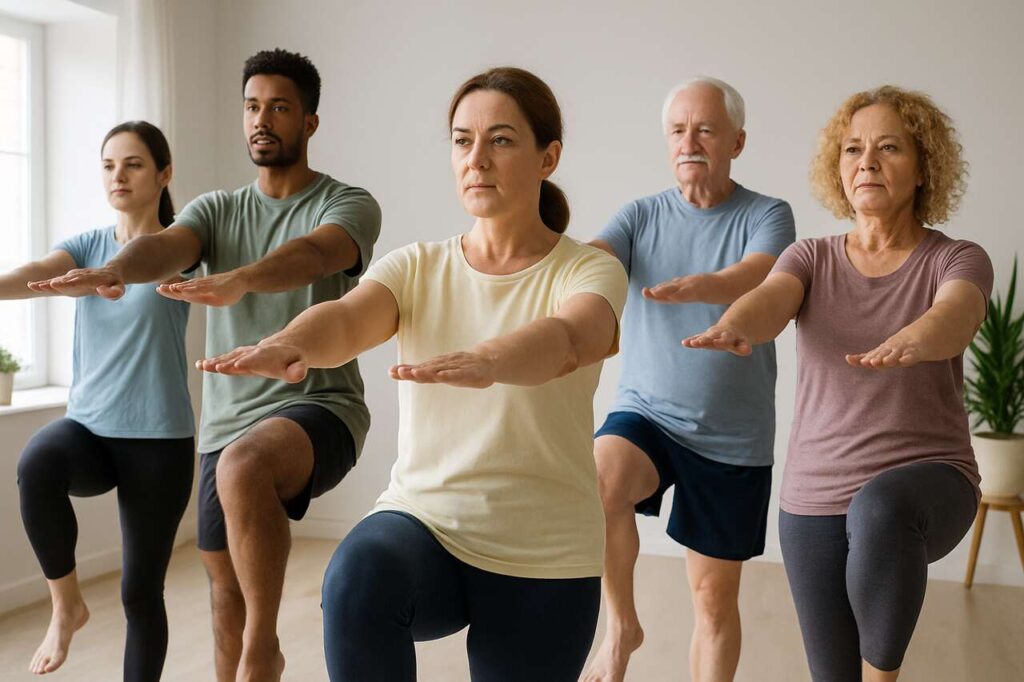
Knee lifts represent one of the most accessible yet powerful standing core exercises available. Begin by standing with your feet hip-width apart, maintaining a neutral spine and relaxed shoulders. Engage your abdominal muscles by drawing your navel towards your spine, then slowly lift one knee towards your chest, aiming to bring it to hip height or higher if comfortable. Hold this position for two to three seconds before lowering with control.
Variations to Progress Your Practice
As your strength improves, incorporate these modifications to increase difficulty:
- Add arm movements by reaching opposite elbow to lifted knee
- Hold the raised position for longer durations
- Perform the movement more slowly to increase time under tension
- Close your eyes briefly to challenge balance further
- Stand on an unstable surface like a cushion
Muscles Targeted and Benefits
This exercise primarily engages the rectus abdominis and hip flexors, whilst the supporting leg works to maintain stability through the gluteus medius and ankle stabilisers. Regular practice improves functional strength for activities like stair climbing and walking on uneven surfaces. The unilateral nature of knee lifts also addresses muscle imbalances that commonly develop from sedentary lifestyles.
Building upon this foundation of core engagement, the next movement adds a dynamic element that challenges coordination alongside strength.
Improving Balance with Heel-to-Toe Walking
Mastering the Heel-to-Toe Technique
Heel-to-toe walking, also known as tandem walking, provides exceptional benefits for balance and coordination. Start by standing tall with arms extended to your sides for initial stability. Place one foot directly in front of the other so the heel of your front foot touches the toes of your back foot. Continue walking in a straight line, maintaining this heel-to-toe contact with each step. Focus on a fixed point ahead to help maintain balance.
Progressive Challenge Levels
| Level | Modification | Difficulty |
|---|---|---|
| Beginner | Arms extended, slow pace | Low |
| Intermediate | Arms at sides, moderate pace | Medium |
| Advanced | Arms crossed, eyes closed briefly | High |
Core Activation Through Balance
This deceptively simple exercise requires constant core engagement to prevent swaying and maintain a straight path. Your transverse abdominis, the deepest layer of abdominal muscles, works continuously to stabilise your torso whilst your obliques prevent lateral movement. The narrow base of support forces your proprioceptive system to work overtime, strengthening the neural pathways responsible for balance.
Real-World Applications
The benefits of heel-to-toe walking extend far beyond the exercise itself. This movement pattern improves:
- Confidence when walking on narrow paths or kerbs
- Recovery from stumbles or trips
- Gait quality and walking efficiency
- Ankle and foot strength
- Vestibular system function
With balance and coordination enhanced, incorporating rotational movements completes a comprehensive standing core routine.
Toning the Core with Torso Twists
Executing Proper Torso Rotation
Torso twists target the oblique muscles that run along the sides of your abdomen, essential for rotational movements and spinal stability. Stand with feet shoulder-width apart and knees slightly bent. Place your hands behind your head or across your chest. Keeping your hips facing forward and stationary, rotate your upper body to one side, pause briefly, then return to centre before rotating to the opposite side. The key is maintaining a stable lower body whilst the upper body moves freely.
Common Mistakes to Avoid
Many people unknowingly reduce the effectiveness of torso twists through these errors:
- Rotating the hips along with the torso, reducing core engagement
- Moving too quickly without controlled motion
- Holding breath instead of breathing steadily
- Leaning forward or backward during rotation
- Forcing range of motion beyond comfortable limits
Enhanced Variations for Greater Challenge
Once you’ve mastered the basic movement, try these progressive options to increase intensity. Hold a light weight or water bottle at chest level, adding resistance to the rotational movement. Alternatively, perform the twist whilst standing on one leg, dramatically increasing the balance requirement and core activation. You might also slow down the movement significantly, spending five seconds on each rotation to maximise time under tension.
Functional Benefits for Daily Life
Strong obliques and rotational strength prove invaluable for everyday activities. These muscles activate when you:
- Reach for items on shelves
- Look over your shoulder whilst reversing a car
- Carry shopping bags on one side
- Play sports involving throwing or swinging
- Perform household tasks like vacuuming or gardening
Understanding how to perform these exercises effectively sets the stage for integrating them seamlessly into your daily schedule.
Incorporating These Exercises into Your Daily Routine
Creating a Sustainable Practice Schedule
Consistency matters more than intensity when building core strength and balance. Begin with two to three sessions weekly, performing each exercise for 30 to 60 seconds or 10 to 15 repetitions. As your fitness improves, gradually increase duration or repetitions rather than frequency. The beauty of standing exercises lies in their flexibility, you can perform them whilst waiting for the kettle to boil, during television commercial breaks, or as a morning routine before breakfast.
Sample Weekly Workout Structure
| Day | Focus | Duration |
|---|---|---|
| Monday | All three exercises, 2 sets each | 10 minutes |
| Wednesday | Knee lifts and torso twists, 3 sets | 8 minutes |
| Friday | All three exercises, 2 sets each | 10 minutes |
Combining Movements for Circuit Training
Create an efficient workout by performing these exercises in circuit format. Complete one set of knee lifts, immediately followed by heel-to-toe walking, then torso twists without rest between exercises. After completing all three, rest for 60 seconds before beginning the next round. This approach maintains an elevated heart rate whilst building muscular endurance and cardiovascular fitness simultaneously.
Whilst enthusiasm for new exercises is wonderful, understanding safety considerations ensures long-term success without setbacks.
Precautions and Tips for a Safe Practice
Essential Safety Guidelines
Before beginning any new exercise programme, particularly if you have existing health conditions, consult with a healthcare professional. When performing standing exercises, always maintain proper footwear with good grip to prevent slipping. Keep a sturdy chair or wall within arm’s reach, especially when first learning balance exercises. Never push through sharp pain, distinguishing it from the normal muscular discomfort of exercise.
Warning Signs to Stop Immediately
Discontinue exercise and seek medical advice if you experience:
- Dizziness or lightheadedness
- Chest pain or difficulty breathing
- Sharp joint pain
- Extreme fatigue or weakness
- Numbness or tingling in extremities
Optimising Your Exercise Environment
Create a safe practice space by removing tripping hazards like loose rugs or clutter. Ensure adequate lighting so you can see clearly, particularly important for balance exercises. If you have concerns about falling, perform exercises near a wall or stable furniture. Consider exercising on a non-slip surface rather than smooth flooring that might cause your feet to slide unexpectedly.
Listening to Your Body’s Signals
Progress at your own pace rather than comparing yourself to others or following rigid timelines. Some days you’ll feel stronger and more balanced than others, and that’s completely normal. If you feel unusually fatigued or unsteady, reduce the intensity or duration of your workout. Building strength and balance is a gradual process that rewards patience and consistency over aggressive advancement.
These three standing movements offer a practical, accessible approach to core strengthening and balance improvement without requiring floor work. Knee lifts build fundamental core strength and hip stability, heel-to-toe walking enhances balance and coordination, whilst torso twists develop rotational power and oblique strength. Together, they create a comprehensive routine that addresses multiple aspects of functional fitness. By incorporating these exercises into your daily schedule with proper technique and safety awareness, you can develop a stronger, more stable core that supports all your daily activities. Remember that progress comes through consistency rather than perfection, so start where you are and build gradually towards your fitness goals.